Before the runways: the Robinson family’s Edinburgh estate
Long before it was an airfield, Edinburgh was a sugar estate. “Edinburgh was the name of one of the sugar estates owned by the Robinson family,” a resident of the area told the Trinidad Express in 2011, and it’s that estate name the US military inherited when it built its overflow airstrip on the land in 1942. The area was known locally for its clay too: Samuel Sookoo, a longtime resident, described the ground beneath what became the airfield as “a clay soil called sapatay”, and said potters travelled from Chase Village to dig it: “Is here all the people making deyas and goblets in Chase Village does come to get the soil for their trade.” That quiet agricultural life ended abruptly when the US Army arrived.
Quick facts
- September 1940: The Destroyers for Bases Agreement gives the US rights to build military bases on British territory, Trinidad included, in exchange for fifty ageing US destroyers.
- 1942: Edinburgh Field opens on the former Robinson family sugar estate, built as an overflow strip for the increasingly congested Waller Field nearby.
- 1942 to 1943: The US Army paves and extends the field into three parallel runways as U-boat activity in the Caribbean intensifies.
- 3 November 1943: Edinburgh Field is officially renamed Carlsen Field (one source gives 1945, an outlier against the weight of evidence).
- Fall 1943: The Navy’s 80th Seabees build a blimp hangar, mooring circle and helium-purification plant for lighter-than-air anti-submarine patrols.
- 26 March 1948: Redesignated Carlsen Air Force Base.
- 28 May 1949: Transferred to the US Navy as NAF (LTA) Carlsen Field.
- 10 January 1950: Formally disestablished.
Built to relieve an overcrowded Waller Field
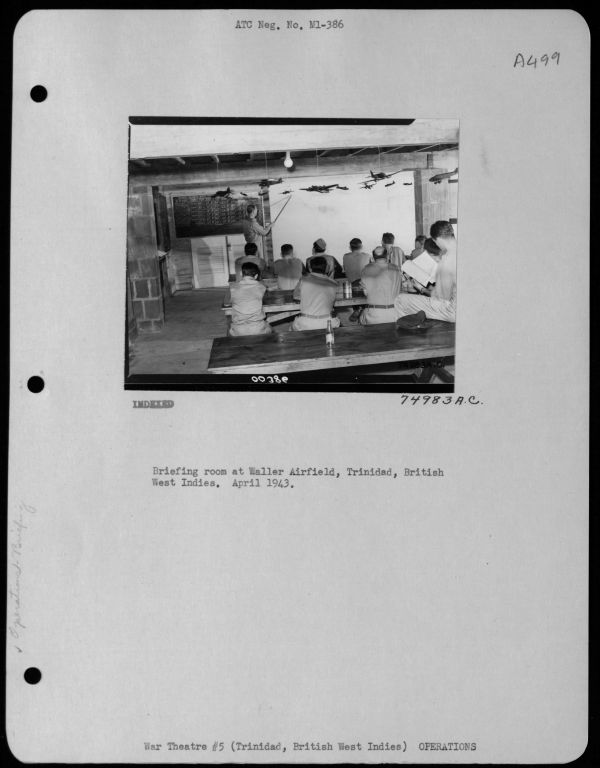
Edinburgh Field’s story begins with the Destroyers for Bases Agreement of September 1940, the same deal that gave the US Waller Field nearby, Trinidad’s main air base and a key stop on the Air Transport Command’s South Atlantic ferry route to Africa and Europe. Waller quickly became a victim of its own importance. As traffic built up, congestion there became so acute that combat aircraft had to be moved out to Edinburgh Field to free up space. What opened in 1942 as a modest overflow strip on the old Robinson estate grew within a year into something far larger.
As German U-boats pressed their campaign against Allied shipping in the Caribbean through 1942 and 1943, threatening the tankers carrying Trinidad’s refined oil to the war effort, the US Army paved and extended Edinburgh Field for combat use. Rather than one lengthened runway, it grew into three parallel paved strips (two at 5,000 by 150 feet, a third, shorter strip kept mainly for emergencies), plus a dedicated area for airship operations. It became, in effect, the largest airbase complex on the island.
The renaming, and an unsolved question
On 3 November 1943, Edinburgh Field was officially renamed Carlsen Field. Multiple wartime and postwar records agree on the date (one Trinidad Express account gives 1945, but it stands alone against the weight of evidence). What none of them agree on, or record at all, is who exactly “Carlsen” was.
That’s a real gap, not just an oversight. Waller Field, by contrast, is thoroughly documented: it honoured US Army Air Corps Major Alfred J. Waller, a decorated WW1 combat pilot who died in a 1937 air crash. No equivalent record for Carlsen has surfaced despite checks against the WW2 Database, Wikipedia, Military Wiki, the Air Force Historical Research Agency’s index, and a Trinidad Express feature on the field’s history, none of which name a namesake, rank or first name. Until a primary source such as a unit history or a wartime newspaper announcement turns up, “Carlsen” should be treated as an unsolved piece of our own local history rather than a settled fact.
A working base, not just a runway
Carlsen Field became one of the busiest anti-submarine and combat bases in the Caribbean. The 25th Bombardment Group made it their headquarters from November 1942 to August 1943, and squadrons rotated through flying B-18 Bolos, later A-29 Hudsons and B-25 Mitchells, hunting U-boats along the shipping lanes (one squadron, the 23rd Antisubmarine, split its time between Carlsen and Zandery Field in Suriname). From late 1943, the base also hosted US Navy lighter-than-air airships, after the Navy’s 80th Seabees built a steel blimp hangar, mooring circle and helium-purification plant on site. British Royal Air Force aircraft used the field too, and US Army infantry and anti-aircraft units defended it on the ground.
What the base cost the people who lived there
The military’s arrival meant eviction for the families farming the old estate land. Samuel Sookoo, who was ordered off his land to make way for the base, recalled it plainly: “When I was told to vacate my land at Carlsen Field, the US authorities told me they will pay for the house, but man does not own land. It all belongs to God.” He waited years before he could return. When permission finally came, it came with a condition, one he attributed to Dr Eric Williams: “You can go back to the land, but build a board house, not a concrete house.”
It’s a reminder that the base’s story isn’t only a story of squadrons and runways. For the families who worked the Robinson estate’s cane and clay, Carlsen Field was land taken and, eventually, unevenly given back.
Closure and what’s left today
The base outlived the war by only a few years. It was redesignated Carlsen Air Force Base on 26 March 1948, transferred to the US Navy on 28 May 1949 as Naval Air Facility (Lighter-Than-Air) Carlsen Field, and formally disestablished on 10 January 1950. Afterwards, the land returned to agriculture, including dairying, before gradually giving way to the farms and residential streets that cover most of the old footprint today. National Flour Mills now holds much of the land.
But the runways left their names behind: Edinburgh, for the housing development now standing on the old airfield and the Robinson estate before it, and Xeres, for a street tracing the line of the base’s second runway.
Frequently asked questions
Where was Carlsen Field?
Carlsen Field was in Chaguanas, Trinidad, on land that had been the Robinson family’s Edinburgh sugar estate. The area is now covered largely by the Edinburgh 500 housing development and Cashew Gardens.
Who was Carlsen Field named after?
It’s not confirmed. Despite checks against multiple WW2 military history sources, no record has surfaced naming who “Carlsen” was. This contrasts with nearby Waller Field, which was clearly named for Major Alfred J. Waller, a WW1 combat pilot who died in 1937.
Why was Edinburgh Field renamed Carlsen Field?
The renaming took effect on 3 November 1943, as the airfield grew from a small overflow strip into a major combat base with three runways and its own anti-submarine and airship operations. No surviving public source explains the specific reasoning or namesake behind the new name.
What happened to Carlsen Field after WW2?
It was redesignated Carlsen Air Force Base in March 1948, transferred to the US Navy in May 1949, and disestablished in January 1950. The land returned to agricultural and residential use, and today the streets Edinburgh and Xeres trace the outline of its old runways.

Author: TriniGo.com
TriniGo.com is about all things Trinidad and Tobago, a Trini home online. We bring information on things to do, restaurants, hotels, Trinidad and Tobago vacations, flight status and more. This is where new experiences begin. Earn Points and Get Goods. Contribute and earn points that you can use on our site and partners. Earn points when you signup, upload pics, write reviews and browse around.